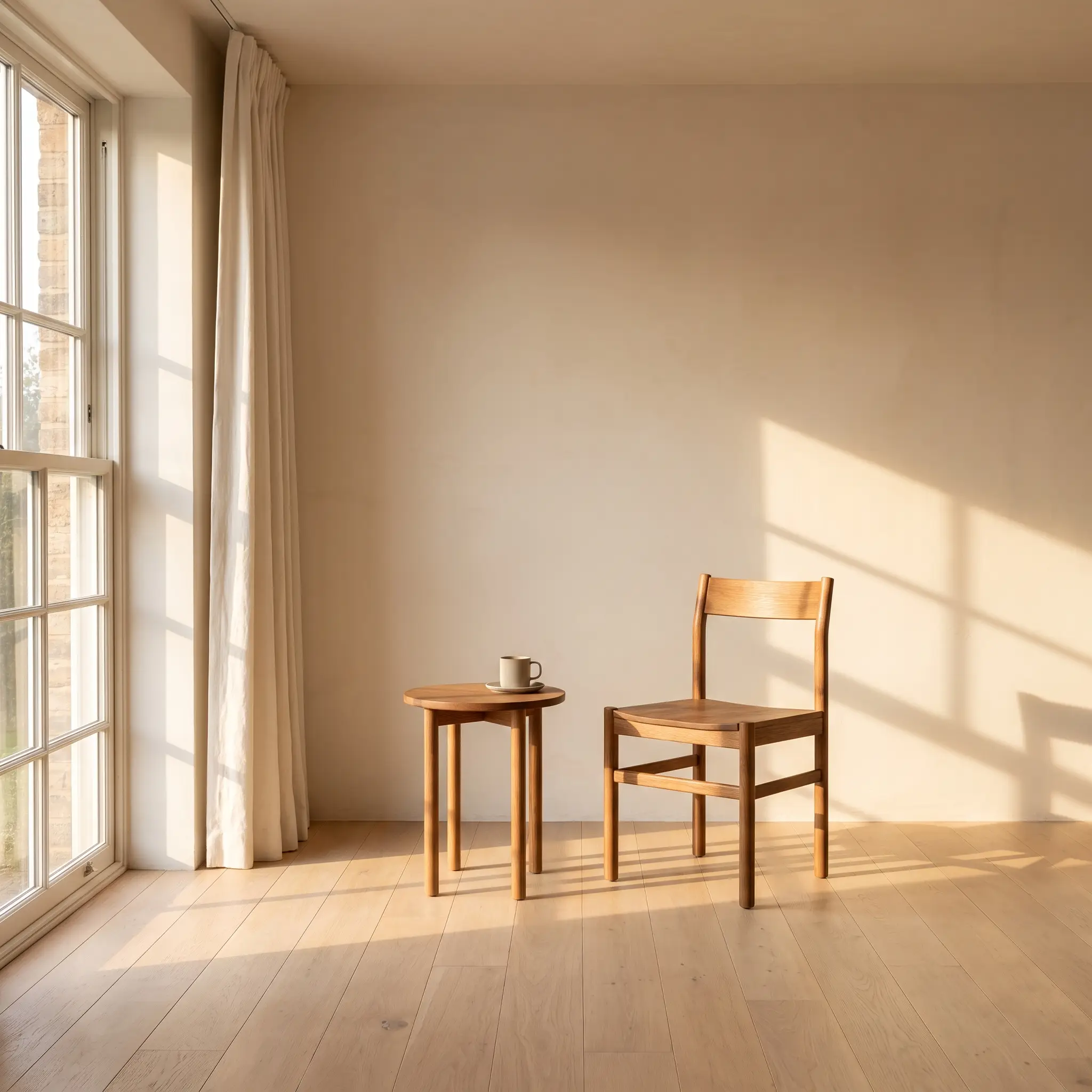
Every year around the back end of September, something shifts in the house and it takes a few days to work out what. The rooms feel different. The kitchen that was bright at seven in the morning is still half in shadow at eight. A patch of sun turns up on a wall where you have never seen one before. Nothing has moved, and yet the place is not quite the same.
What has changed is the angle. After the September equinox the sun sits lower in the sky, rises later, sets earlier, and crosses at a shallower arc. Light that came almost straight down in July now comes in sideways. It reaches further into rooms, lies across floors instead of pooling on windowsills, and picks up a warmer colour as it travels through more atmosphere to get to you. The house has not changed. The angle of approach has.
Most of us respond to this by reaching for a switch. That is a reasonable thing to do, but it skips a step. For a few weeks the daylight in your home is doing something it does not do at any other time of year, and it is worth a little attention before you paper over it.
Find the good hour
Every home has one. A stretch of forty minutes or so when the light does something worth stopping for: through a particular window, across a particular wall, catching the edge of a table. In summer it might be early. In autumn it tends to move later and last longer, because the sun is travelling a shallower path and takes its time.
The only way to find it is to notice. For the next week, when you happen to walk through a room and think oh, that’s nice, look at the clock. Three or four data points is all you need. Most people discover their house has a good hour they have been walking past for years, usually somewhere they do not sit.
Then the obvious question: is there a chair there? Often there is not. The chair is in front of the television, or facing the room, or pushed against the one wall the sun never touches. Moving it is free.
Move one thing
Rearranging a room sounds like a project. It is usually one object.
A table pulled two feet closer to a window. A chair turned forty degrees so it faces the light rather than sitting side-on to it. A lamp retired for the season because the corner it was lighting now gets an hour of sun instead. A mirror moved to a wall opposite a window rather than beside one, where it does nothing.
The test is simple: go and sit in the spot at the time you would actually use it, and see whether you want to stay. Most rearranging fails because it is done at the wrong time of day, by someone standing up.
Let the evening be evening
The other half of this is what happens when the daylight goes, which in autumn is earlier every week.
A single bright ceiling light flattens a room. It is efficient and it is useful when you are looking for something, and it is a poor way to spend an evening. Two or three low, warm light sources at different heights will do more for a room than one strong one overhead, and you almost certainly already own them — they are just all switched on at once, or all in the same corner.
Try one week of not touching the ceiling light after dark. Use whatever lamps you have, spread out, low. It costs nothing and takes a few days to stop feeling underlit, at which point going back to the overhead feels like being in a waiting room.
Clean the windows
Unglamorous, and the single largest change available to most homes at this time of year.
A summer’s worth of dust and rain marks on the glass costs you a surprising amount of light, and you will not notice it happening because it arrives gradually. You notice it afterwards. Late September, while the weather still allows it, is the right week for this. Inside and out; the outside is where most of it is.
While you are there, look at what is in front of the windows. A row of tall things on the sill, a curtain that does not pull fully clear of the glass, a blind that stops halfway. Each of those was a decision made in a different season, and most of them were never revisited.
The point of all this
None of it is a project. There is no shopping involved, and anyone who tells you that you need to buy something to make your house feel better about October is selling you something.
What is genuinely true is that for about six weeks the light in your home is doing something specific and temporary, and that noticing it is a small, free, mildly interesting thing available to anyone with a window. Find the good hour. Put something to sit on in it. Clean the glass. Turn the big light off.
The light will keep changing whether you look at it or not. It is just better when you do.